The Camel Coat
SHORT FILM · 16 MIN · COLOR · ENGLISH · ARABIC · HEBREW · ISRAEL
Logline
She arrived certain she was welcome. Lima closed the gate..
Synopsis
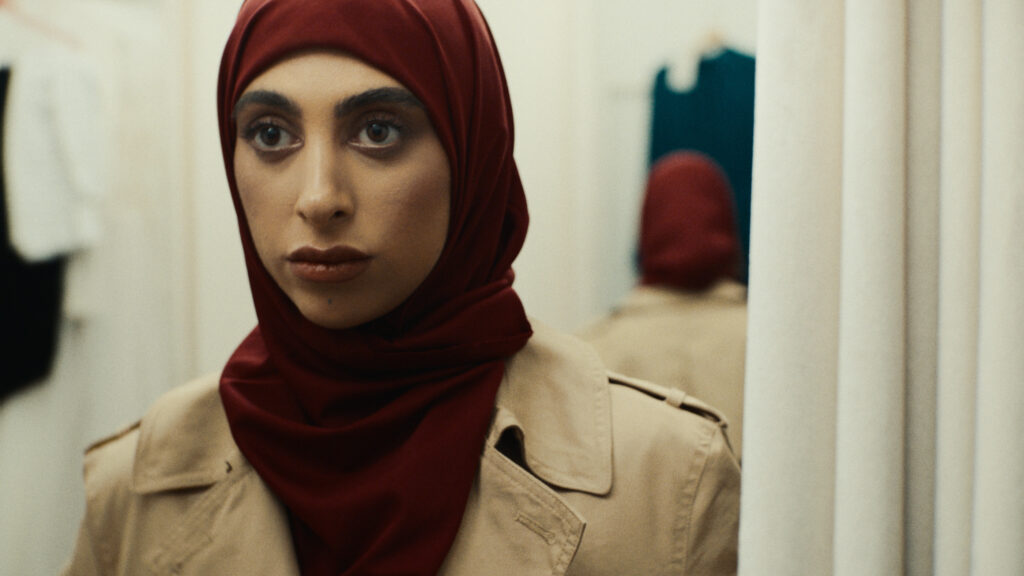
Maryam, an American Jewish tourist in Jerusalem, watches Lima, a Palestinian woman, try on a camel coat in a clothing store. The watching is not neutral. Lima leaves without the coat. When Lima’s wallet turns up, Maryam decides this is something she should do herself.
She buys the coat. She will bring it along with the wallet. This is what good people do.
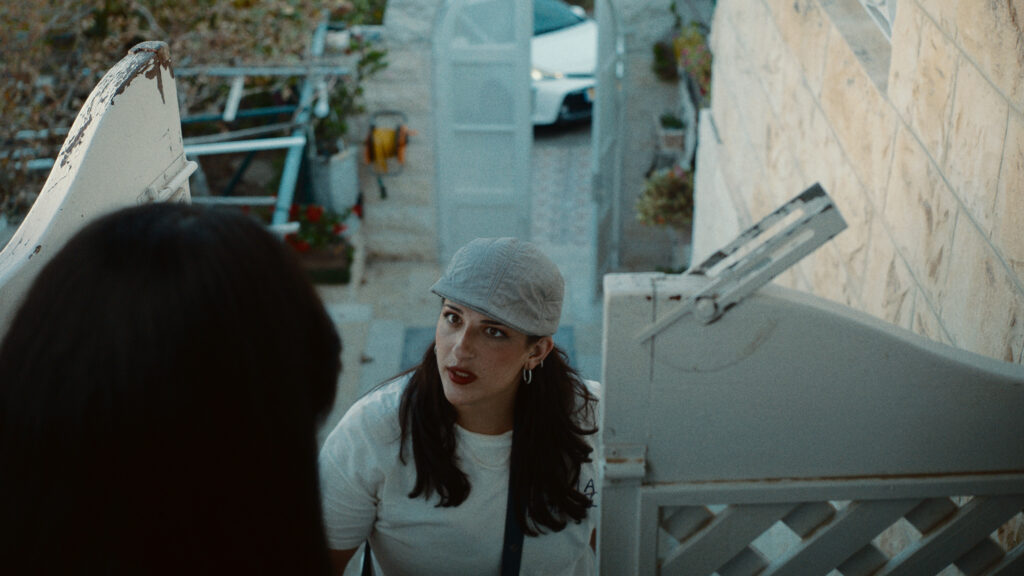
Over the course of one day, through a taxi ride with Tamir, a purchased coat, and a wallet she has been dipping into, the wallet arrives at Lima’s door somewhat lighter than it left. Lima accepts the wallet. She declines everything Maryam came to give. At the door, Maryam says she thought they had something. Lima closes the gate. She returns to her phone call.
The film stays with what that refusal costs neither of them to perform.
Director’s Statement
I watch for the moment when a gesture crosses a line without announcing itself.
The film opens with a selfie. Maryam stands in front of an Elvis statue, phone raised, singing Hound Dog into the camera. The image is vertical, the lighting bad, the framing wrong. Then it cuts: Lima in an overexposed white space, moving through the frame in the camel coat like she owns it. Cinematic. Correct. Then that image pulls back too: Lima is simply trying on a coat in a store, and Maryam is watching her. The film’s entire project is inside those two cuts.
It started with something I wanted to observe without resolving. A look that lingers. The watching is not political. Or not only. Something held just a beat too long. Desire and politics operating on the same register, through the same gesture, without either canceling the other out.
A shopkeeper dismisses Lima’s wallet with a question: what should I do, return it to Hebron. Maryam hears a plan. What follows is a day of decisions she doesn’t second-guess.
Lima lives in a quiet Jerusalem suburb. Maryam doesn’t know this yet. She is already on her way.
The camera stays close and still. It doesn’t move ahead of her or pull away. When Maryam leaves a scene, the camera sometimes stays. With the street. With the man smoking by the ATM. With a city that was here before she arrived and will continue without her.
All locations are authentic. The Arab communities whose spaces we entered gave us their time and their homes. The casting honors the communities it represents. The only person who stands out is the protagonist. The camera notices.
The film makes fun of one person. The American tourist. Who happens to be me.
Lima sees Maryam running away, the cab already leaving. She closes the gate. Like a lady. She continues to her house, her phone call, her life.
At the Elvis diner, Maryam tells Tamir she thinks she should move here. He looks at her and turns away. The credits begin. The film cuts back to the Elvis statue: Maryam singing Hound Dog, vertical frame, someone else holding the camera this time. Someone watching her. She doesn’t know.
Elvis recorded a song that belonged to someone else, made it his own, and became iconic.
The film doesn’t explain what that means. It doesn’t need to.
Film Details
Subtitles
Aspect Ratio
Format
Year
English
1.33:1
Digital · Color
2026
Credits
Writer and Director
Producer
Cast
Yocheved Feinerman
Raz Kotik
Meryl Litwin
Aviv Musli
Adan Matar
Director of Photography
Editor
Institutional Production Support
Dmitry Savinov
Alexandra Koroleva
Minshar School of Art, Tel Aviv
Gallery